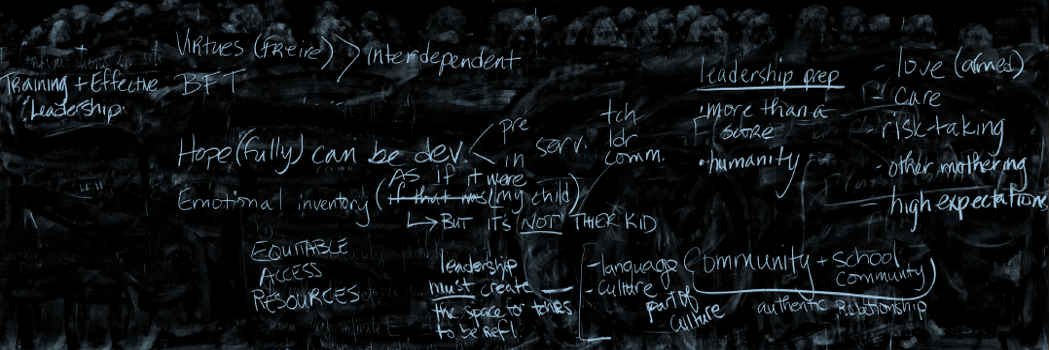
This week’s readings have me thinking about the exceptionally holistic caring that Black women educators can enact. It seems like the women we read about this week take holistic to another level. It’s not just making sure the student is fed and plays instruments and is physically active and learns social skills (in addition to academic instruction, of course). It is holistic in that these Black women educators want to make sure their students are ready to handle the oppressive social and political world. Even beyond that, they care in a way that can drive the students to be ready to change that social and political world themselves. It’s an expanded kind of care that is not just about the student as an individual, but the student as an agentic social, political, and spiritual being. Many of the women we read about found some ridiculously creative ways to care for their students in the micro-est, most immediate ways AND in the structural, systemic, macro ways. Simultaneously! I dunno. I don’t have anything very academic to say about it. I am mostly amazed and trying to be better after this week’s readings.
Fatima Sherif Week 4
“Caring” specifically in the work that services others should not be an anomaly. The assertion that empathetic caring is distinguishable from normative caring because it evokes emotions that push others to go further in finding a solution is concerning (Bass, 2012). I feel like empathetic caring should be the norm. However, to care and utilize caring as an act of resistance to combat structural racism in education, an investment in the emotional well-being of students of color must exist (Wilson, 2015). So how do we find a solution? The cure to all of the education woes goes beyond exclusively hiring black women educators/leaders. Leaning into black womanist theory and black feminist theory may assist with paying the education debt. Black women educators leaning into their maternal instinct motivates, protects, and essentially provides the tools for survival in an education environment that has traditionally rejected black education from students to scholars (Beauboeuf-Lafontant, 2002). Thus, highlighting Black women and their epistemological contributions can serve as a way to combat the disproportionality we see in education.
The readings for this week have prompted me to ask a radical question “Should black education be left exclusively in the hands of black educators?” And a second tiered question that I had was Are disadvantaged people the only ones in need of “rescuing”? I ask this because I feel like those who are complicit in maintaining a system of racial and/or class hierarchy are in distressing form as well. Imagine if they had to unpack their “stuff” in the ways that bipoc’s have to?!?
Command of a Narrative
Week 2: Mariatere
Dr. Ladson-Billings asks: “Well, what did you mill?” Textiles… (Video, 27:00)
To answer some of the questions posed by Lucy, Kushya, August, and Fatima, I felt heavy reading the first two articles. Yes, we know that race continues to be a significant factor in determining inequity and life outcomes. We feel the weight of it and see it at play in our schools. But as I reread, Toward a Critical Race Theory of Education (2005), I felt strengthened when I came to, “Historically, storytelling has a kind of medicine to heal the wounds of pain caused by racial oppression” (p. 57). I understood the message differently this time. As Dixson & Anderson (2018), and many of you have discussed, while narratives by themselves are not enough, they are an indispensable tool I need to learn how to use. When I listened to Dr. Ladson-Billings’ talk at Teachers College later on, I got a better sense of the kind of medicine she was pointing to. Not the ones that mask the pain and make us feel better. She was talking about the old school herbs that grow outdoors. Medicines purge and leave no room for the racist practices, policies, and curriculums that impact our schools and communities.
As I listened to Dr. Ladson-Billings’ address, I was interested in understanding how counter-narratives can serve to engage people in the issues and data, get them to care and take action. I wanted to understand: 1) how she chose to construct and weave the narrative she had crafted, including what materials she had used, 2) the actual talk, meaning the words, images, messages, and knowledges that made up her talk, and 3) what was happening at the juncture of her talk and my participating (audiencing). I couldn’t help myself. All week I’ve been thinking about researchers can use use art, including storytelling, to deepen the understandings of our audiences. As a master storyteller, counter-narrative weaver, I sat intently by her side to listen and learn. She knows the power of selection, so what had changed and what had remained consistent from her seminal (2005) work? The message I received was: Be courageous. Counter-‘narrativing’ is not reserved for getting on stage or publishing. It is daily praxis, reflection and action. This is where I found some hope.
Week 2 Post – Lydia
I am an educator at an organization that is purportedly invested in addressing racial educational inequality despite not mentioning in their mission statement. I am reminded of Ladson-Billings and Tate writing in 1995 that racial educational inequality is to be expected in “a racialized society in which discussions of race and racism continue to be muted and marginalized” (p. 47). Internally we may acknowledge that the overwhelming majority of students we serve are Black and host anti-racism trainings for instructors but will never properly situate our work in the context of the racialized illnesses plaguing our education system like segregation and curriculum steeped in whiteness. Despite its absence in the mission statement, race and racial diversity is central to the website’s visual story
When I think about this work and this organization tossing around terms like “anti-racism” and “critical race theory”, I am pushed to think of Dixson and Anderson (2018) calling for critical race theory to become more than an intellectual movement. My organization is doing the work on some level but I wonder about the understanding people have about what Critical Race Theory really has to say about our work and how we do it. I appreciate Dixson and Anderson seeking to establish some concrete boundaries around what Critical Race Theory is because maybe, just maybe, it might be possible for organizations like the one I work for to get a handle on how to employ more racially critical lenses on program development and implementation.
Tarilyn’s Week 2 Discussion Post
“Possession—the act necessary to lay the basis for rights in property—was defined to include only the cultural practices of Whites. This definition laid the foundation for the idea that whiteness—that which Whites alone possess—is valuable and is property.” (Harris,1993 as cited in Ladson-Billings & Tate, 1995, p.59)
Several of the concepts uplifted in the articles by Ladson-Billings & Tate (1995) and by Dixson & Rousseau Anderson (2018) resonated with my observations working in the education and non-profit sectors over the past 15 years, as well as my own experience as a Black student. One in particular that struck a resounding chord was the discussion of whiteness as property. In both articles, four different “property functions of whiteness,” as proposed by Harris (1993) are highlighted and explored. I could easily identify examples for each one, but will zoom in on “rights of disposition” and “the absolute right to exclude” for this particular post.
Rights of Disposition
Ladson-Billings & Tate (1995) note that “When students are rewarded only for conformity to perceived “white norms” or sanctioned for cultural practices (e.g., dress, speech patterns, unauthorized conceptions of knowledge), white property is being rendered alienable.” (Ladson-Billing & Tate, 1995, p.59) Attending an all-black elementary school with an exclusively-white administration and teaching staff, as well as attending a predominately-white middle and high school, the policing of the bodies, behaviors and speech of Black students and families was rampant. I also witnessed (and unfortunately inflicted) some of the same policing as a new classroom teacher working for “no excuses” charter school in Brooklyn. It took years of work (and continued work) to unlearn internalized notions of respectability, education for the sake of competition and success in a capitalist society, and assumed cultural superiority of dominant society. I still see the pervasiveness in how Black and Brown children are policed in our school-based programs.
An area of my current work where rights of disposition is prominent, is in discussions around Social Emotional Learning. While SEL has been one of the hot topics and education waves for a while now, conversations about SEL through a lens of racial justice and equity are more recently taking off. Critique of the popular standards and models for SEL focuses on the fact that they lack cultural-responsiveness and emphasize white and western notions of behavior as the ideal to be reached. In my own workshops on SEL, I hazard after school staff against using SEL-focused practices and lessons to control and police children’s natural and valid emotional responses and modes of expression This is particularly important for Black and Latinx children whose emotional responses and modes of expression are punished and criminalized. I also challenge them not to confuse developmental-supportive social and emotional learning with behavior management, which is almost exclusively about control and policing vs wellness and well-being.
The Absolute Right to Exclude
According to Ladson-Billings & Tate (1995), “Whiteness is constructed in this society as the absence of the “contaminating” influence of blackness.” (Ladson-Billings & Tate, 1995, p.60) I have seen this show up in the treatment of Black educators, counselors and families, the absence of accurate and thorough teaching of historical and current events, the exclusion of BIPOC authors and stories from ELA curriculum and schools booklists, and in the current backlash from teachers and parents against the Black Lives Matter at School Week of Action programming, principles and demands.
The “absolute right to exclude” connected naturally to the function of counternarrative for me. Lawrence (1995) notes that, “we must learn to trust our own senses, feelings, and experiences, to give them authority, even (or especially) in the face of dominant accounts of social reality that claim universality”. (Lawrence, 1995 as cited by Dixson & Rousseau Anderson,2018, pg.4) If possession is a characteristic of whiteness and this manifests as “ideological”, “discursive”, and “representational” racism (Cole, 2019), then it makes sense that emphasis would be placed on owning, controlling and telling our own stories. I see counternarrative at play in my own work in the literature and literacy world through movements like #ownvoices and #disrupttexts movements.
Quinn Reading Response #1
Radical Care Sp21
The combination of the two articles—the 1995 (master)piece by Ladson-Billings and Tate along with the 2018 article by Dixson and Anderson—helped me to make a connection between two ideas that I had previously seen as separate: the seminal notion advanced in Critical Race Theory of whiteness as property; and the pernicious role of the property tax as the basis for school financing in this country.
When I first learned how schools are financed in the U.S., I thought the system seemed strange. Why, I wondered, are schools financed in such a different way than any other public good? It took me a while to figure out that all the rhetoric about the democratic ideals of local control as its basis was really a cover for something that is neither democratic nor ideal. Using the property tax as the basis for school financing results in inequities that privilege the wealthy and starve the less affluent. Right here in New York State, we see the results: that schools in Scarsdale spend $31,118 per student while schools in Utica allocate only $17,128. Many advocates, including Michael Rebell (who has led the fiscal equity court cases in New York State over the past several decades), view our current system as racism-in-action—not as a by-product or unintended consequence but, rather, as a system that was designed to do exactly what it does, which is to discriminate on the basis of race and its intersectional neighbor, class. A second response I had to this week’s readings involves the question posed by Dixson and Anderson in their title, Where are We? I appreciated their explanation of the double meaning of their query: “On the one hand, it references the mapping metaphor we have adopted to explore the existing literature and to ‘draw’ boundaries around CRT scholarship in education…But what has been the impact on schools and communities of color? Notably, several CRT scholars have called for critical race theory praxis—an engaged approach to CRT that move from campus to community” (129). This call to action/application has the potential to address issues of radical transformation and care that are the focus of our course.
Week 2 Reading Response – Lucy
The piece that I was struck most by in the Dixson article was the exploration of property and in particular whiteness as property, as it plays out in the “culture of Whiteness” of teacher education programs, and by extension, the teaching profession. I was struck in particular by this line, “Whiteness operates as a form of property by which preservice teachers that possess the experiences, perspectives, knowledge and dispositions aligned with and valued by the dominant White society find reinforcement and success” (p. 128). This is something I think about a lot in terms of the school where I teach, which has an almost all-white administration, and a predominantly white (myself included) teaching staff. Teachers who align with the toxic culture of white supremacy delusion (perfectionism, defensiveness, paternalism, either-or thinking, power hoarding, fear of open conflict, and most central to whiteness culture, anti-Blackness), end up getting into positions of leadership, and perpetuating and reifying this culture, while teachers who do not align with this culture or actively push against it are undermined and pushed out. It is violent for both students and teachers.
I was also struck by what Dixson describes as the “propertied right to determine meaning” (p. 128). I found this exceptionally powerful, and a way to name the dynamics of whiteness that work to ensure its perpetuation, especially in schools and among white educators that self-identify as being “progressive” “caring” “liberal” or “anti-racist”. As Dixson et al explain, white preservice teachers use this aspect of whiteness as property to “construct a definition of White privilege devoid of attention to structural power;” thus ironically exercising “their real White privilege—the propertied right to determine racial meaning—to deny their individual participation in the collective, structural racism that perpetuates racialized student failure. This is an exclusive right only engaged by the dominant racial group.” (p. 128). White teachers and administrators naming themselves as anti-racist, while simultaneously reifying systems of oppression, is the ultimate form of this “propertied right to determine meaning.”
When a critical praxis, such as CRT, is implemented by those with a vested interest in perpetuating and maintaining toxic whiteness and anti-Blackness, then the language of that praxis can be manipulated, flattened, and shifted to serve those interests, while providing a veneer of “progressive liberal goodness”. Ladson-Billings (1995) explained this tension best, when she described it as “the difficulty (indeed, impossibility) of maintaining the spirit and intent of justice for the oppressed while simultaneously permitting the hegemonic rule of the oppressor” (p. 62). I am left wondering how to interrogate and dismantle that particular aspect of whiteness as property, and whether and how a praxis of CRT can do so, or can do so on its own, or can do so if the structures of power remain unchanged.
Kushya’s Response
This week’s readings put into words the reasons behind a lot of the hopelessness that I have been feeling as a teacher of color working in a white suburb. The first idea that resonated is that our society is based on property rights as opposed to human rights and that whiteness is the most tightly defended property of all. There are countless structural examples that point to this truth, so I don’t need to delineate them here. However, to me, it is worth mentioning how consistently shocked I find myself with the way in which educators, administrators and parents frame education as a means of securing privilege for certain children as opposed to ensuring the wellbeing of all children. After reading the Ladson-Billing and Tate article, I just kept wondering what a school that was built on human rights would look like and – as mentioned in the jamboard last week – whether it is even possible for an institution in our country to hold humanist values.
Further, as a Black teacher in a white institution, I constantly find myself feeling like it’s one-step forward and two steps back. This was beautifully explained in Dixson and Anderson’s piece as interest conversion. This has also truly come to play in the pandemic. Realizing that it is in their best interest to “address race,” my school like so many has created a Diversity Equity and Inclusion committee. Staffed by some well meaning history and english teachers and the few teachers of color in the district, we met twice to discuss how we can create a more inclusive community, but the only win I have seen is a Chinese author is coming to talk about her experiences. Meanwhile, the administration leaves untouched many policies that rarify whiteness – tracking, unjust hiring and tenure practices, curriculum control by certain parents.
My research interests are how teachers of color use their emotions to develop agency across different spaces. This ties in with the topic of this week because sometimes, like when I think about the fact that white people only allow change to occur as far as it benefits themselves and re-entrenches whiteness, I feel so hopeless. I just wonder – and think that it’s really important and interesting to study – how other teachers navigate their emotions as they watch institutions try to systematically reduce positive outcomes for Black people.
Where are we going?
To start, I just have a fun anecdote that relates to some of the things Dr. Ladson-Billings mentioned in the video. It’s not super related, so you can ignore it if you want. So when I was a kid, my family’s version of “going south” for the summer was going to Milwaukee to spend a few weeks with my granny. And we spent most of our time on the south side where all of the Black folks live. So when I was 5 or 6 I just thought that Milwaukee was an exclusively Black city. But then one day, granny brought my brother and I to the mall to see a movie (Mayfair mall, I think?). And there were only white people there! I remember looking around for literally any other Black people and there were none. I was as shook as a 6 year old can be. I remember looking up at her and asking “Granny, are we still in Milwaukee? Where did all the Black people go?” and she laughed so hard. Then she explained that Black people don’t live over there. They live in her neighborhood. And that was that. I’ve always felt like the fact that a 5 or 6 year old could notice the segregation in Milwaukee is very telling of what it’s like there. Especially considering that I am from Minneapolis, which is also hella segregated. Alright. I am done. The real response is below this.
Maybe I am just going through a bit of an afro-pessimist phase, but after this week’s readings, I am not feeling super confident in CRT in education. It was exciting to read the 1995 piece again. You can really feel how hopeful Ladson-Billings and Tate are about their contribution. It feels meaningful and powerful. It feels more critical too. it feels like this could be the thing that finally opens everyone’s eyes and fixes everything. Then you get to the Dixson and Anderson piece. Of course it’s a literature review so it can’t be THAT spicy. But it feels a bit more defeated. (Or maybe I just feel defeated. I hope I am not projecting.) It lays out big ol list of characteristics and boundaries (which is rough on the eyes, I must say). And neatly categorizes the past research into little buckets. So it almost feels like the act of laying these ideas out so neatly takes away the future possibility of it. It’s like CRT in education sold out a bit. Then we have Dr. Ladson-Billings speak at Teachers College. Which is great because she explains ideas so much more clearly than anything my mind could come up with. But even then, I did not feel any hope for future research, future changes, new theories, etc. It just felt like more bad news about Black kids in education. So I am truly wondering what the next steps are for CRT in education. Can we re-invigorate it? Should we? Should we find something else altogether? Would that new thing suffer the same fate as CRT? Or am I just being pessimistic and cynical?
Fatima Sherif Response Week 2
The article by Ladson-Billings and Tate was written in 1995 and I am still able to read it as though it was written in 2021. To be honest, I am tired. The argument of race existing as a significant factor in determining inequity in the U.S. remains true (Ladson-Billings & Tate, 1995). This fact is evidenced in multiple areas of American life, from education to healthcare but I digress. Critical Race Theory has offered to the discourse a lens that can be used to highlight the racialized experiences and inequities in education (Ladson-Billings & Tate, 1995). In reading Dixson and Anderson (2018) I was reminded of the power of counternarratives. Similarly, I am in full agreement that counternarratives have the ability to combat hegemonic white views that have been reserved as the basis for situating Black people in history and education. However, I also recognize the limitations of focusing solely on counternarratives without using other tenants of Critical Race Theory to unpack the narratives and analyze the insidious nature of how racism operates ( Dixson & Anderson, 2018). Perhaps the reason educators and researchers alike fixate on counternarratives is because so much of the Black story has a. Been told by “other” people and b. The silencing of black people has led to an unquenched desire to be heard and seen as epistemological experts. Thus, is the call to push counternarratives further too much too soon when there is so much more of the story to tell and falsities to combat?

