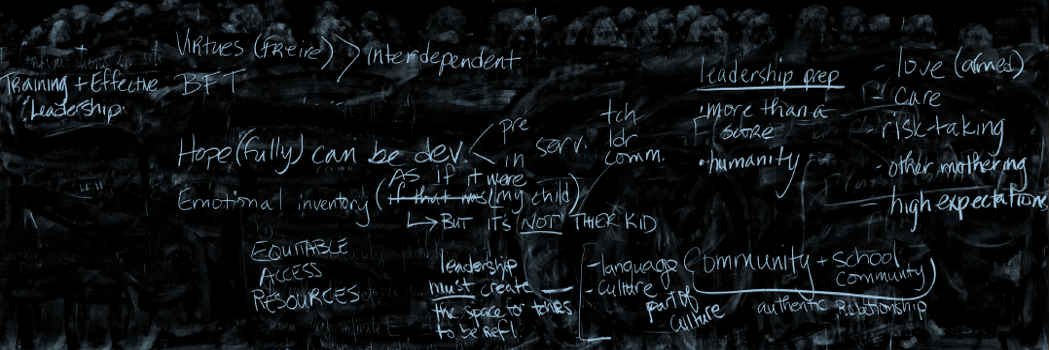
As someone who has been working in education for nearly ten years now, I find that I spend the majority of my time thinking about education and the education system. It has become almost a default to blame our social ills on the school system and all of the problems within it – the inequitable distribution of resources, poor teacher preparation, etc. In the same vein, when you see the education system as the institution to blame then it simultaneously becomes the institution that we need to fix. As Miller et. al names, “The prevailing thought seems to be if we fix the schools, the rest of the ducks will fall into order, that is, employment and home ownership rates will increase, crime and drug use will go down, and so on” (Miller et. al 2011, p. 1080). The readings this week poked holes in this assumption and I am left grappling with the question: “Why do we put so much of our attention and resources into trying to fix what goes on inside low-performing schools when the causes of low performance may reside outside of the school?” (Miller et. al 2011, p. 1080). This profound reminder makes me think a lot about the need for more interdisciplinary work. Given the complexity and pervasiveness of the problem, we need to work together across disciplines in order to see and respond to the interconnected nature of oppression across all institutions. Freire reminds us of the importance of solidarity and dialogue as tools for our collective freedom and must be relied upon in order for social change to occur. He reminds us that we must hold space for both critique and hope in the fight for freedom and that above all, “love is required to maintain hope in the face of despair” (Rivera-McCutchen 2019, p. 237). While critique alone can lead to feelings of despair, love and hope provide the energy to sustain the fight and to retain a vision of possibility.
Kushya’s Response (3/9)
I really enjoyed this week’s readings for many reasons. First of all, similar to the week when we read about the womanist ideology, this week’s readings built upon the work of Paulo Freire. What I love so much about the way that these readings were curated is that I can clearly see the way that ideas develop over time in academia, and I can begin to see myself entering into a conversation such as the one that unfolded over this week’s readings.
In addition to one another, this week’s readings built on a couple of themes that I have been thinking about in this class. For instance, the idea of caring or loving educators being willing to take on risk was touched on in many readings. Rosa’s piece gave two current and specific examples of the risks that educators undertake when they approach the role of principal through the framework of armed love. Further, Friere and Darder spoke specifically about the concept of fear and how fear is a necessary element of our quest for liberation. As someone who is very interested in studying emotions, I really enjoyed the way that Friere approached fear. Rather than as something to run away from, to Friere fear is an indicator that you are an educator that is on the right path. Only by recognizing and working through fear can we develop courage. This discussion of fear reminded me of Audre Lorde’s idea that we can learn to work through fear like we learn to work through exhaustion. (She said it much more beautifully, but I cannot find the quote right now.) I find this conception of fear as a bearable companion especially meaningful when coupled with Darder’s assertion that “many administrators … instill a fear of freedom.” Not only can we work through fear, but we must because anything worth doing is scary by design.
Lastly, I found comfort in Miller’s reminder that Freire’s work is not a “radical recipe.” Sometimes I get frustrated as a teacher-educator because I mostly teach white women of relative privilege. Thinking about education “that transforms the space where children, rich or poor, are able to learn, to create, to take risks, to question, and to grow” helps me to see the ways that even those of privilege can learn to fight to change the status quo.
Fatima Sherif Week 6
The readings for this week highlighted the contributions of Paulo Freire and his transformative approach to education by centering love, liberation, and humanity in education. The readings resonated deeply with me because at the crux was this idea of being fearless in the pursuit of transformative education. I have always lived by the motto of being fearless. Fearless in the goals that I pursue and living fearlessly as I push for equity in education. “Armed love” is exactly what is needed if we want to see changes in society and the field of education as it activates the love in “armed love” and also the notion of being fearless “the love required in education for liberation and equality cannot be timid” (Rivera McCutchen, 2019, p. 237). The issues within urban education have less to do with the people that are seeking education and more to do with the structural, systemic, and environmental violence that is experienced by Black and Latin-X communities (Miller, Brown, & Hopson, 2011). Similarly, to find solutions and address the issues that plague our education system, we have to look beyond individual circumstances and recognize how interconnected political and economic forces are in perpetuating injustice (Darder, 2002). I agree with Paulo Freire (1998) in his assertion that we must listen to everyone regardless of their intellectual level and we must listen without elitism. However, why do I feel like the people that are heading to this advice are not the people that need to hear this? While encouraged by this week’s readings because I feel like I have tangible approaches that are not only evidence-based but are also in alignment with my educational philosophy, I still have questions. I want to know what our decision-makers are being taught and what qualifies them to be education leaders charged with improving our education system? Because as far as I’m concerned, I don’t see any of the recommendations and/or philosophical approaches incorporated in the work that they do to improve our education system. But, I digress! Maybe it’s the people in this class that is meant to be transformative and for what it’s worth I believe in each and every one of you!
Jane Quinn Response/Radical Care Week #6/March 11, 2021
This week’s readings provided an opportunity to learn about the work of Brazilian educator Paulo Freire from several perspectives—including Freire himself, a colleague who studied and interacted directly with Freire (Antonia Darder), and several scholars who applied Freire’s teachings to the practice of urban school leadership (Peter Miller, Tanya Brown, Rodney Hopson, and Rosa Rivera-McCutchen).
Freire shows great respect and high expectations for teachers in his letters “to those who dare to teach,” communicating his empathy for the difficulty of their under-valued labors while also providing encouragement and advice. He speaks clearly about the characteristics needed by educators engaged in the struggle that is public education: “humility, lovingness, courage, tolerance, competence, patience-impatience, and verbal parsimony” (p. 212). I found his frequent use of the literary device oxymorons (for example, in “uncertain certainty” and “insecure security”) somewhat distracting; at least for me, these phrases called attention to themselves served to undercut the power of his overall message about the urgency of educators addressing oppression in all its forms and about the centrality of love in the enterprise (“without which their work would lose its meaning”).
Darder’s personal reflections about her work and friendship with Freire over many years add important detail to his interaction with and influence on scholars of U.S. education, including herself. Her description of their disagreements about the importance of racism “as the major culprit of our oppression” (p. 501) is timely and compelling. Darder takes particular note of Freire’s concept of armed love, observing that “If there was anything that Freire consistently sought to defend, it was the freshness, spontaneity, and presence embodied in what he called an ‘armed love’—the fighting love of those convinced of the right and the duty to fight, to denounce, and to announce” (p. 497). Rivera-McCutchen demonstrates the contemporary salience of this concept by applying it to an analysis of two educational leaders in New York City—Jamaal Bowman and Jill Bloomberg—who actively resisted oppressive policies that stood “in the way of access to high-quality educational experiences and opportunities” (p. 238) for Black and Brown students in the Bronx and Brooklyn.
Miguel – Week 5
(Just realized my post was never published)
I started with Khalifa, Gooden & Davis (2016) and I had to pause a few times after reading particular sections. I first paused when they mentioned that culturally responsive leadership alone cannot solve the major challenges (p. 1273). My second pause after reviewing the definition of terms. Another pause came when reviewing the results and the section highlighting “challenging whiteness”. Each of these pauses happened because I had some inner dialogues with myself. Tilman (2004) was an absolute joy to review. I really enjoyed the historical context for 3 reasons: 1) I need to be aware of the historical context of multiple things in general, 2) Tilman (2004) offers the multiple complexities regarding segregation and Black families still valuing schools (an act of resistance), and 3). It provided specific info on the Black “principal in a pre-brown era” which is something I have not ever considered.
Some of the questions/thoughts I marinated on was:
- What do I challenge the most? why?
- How can providing a definition of terms for my own research make me a better scholar?
- The notion of “a single answer”
- Am I who I say I am?
- How might I lean into Tilman (2004) more and draw connections to my research?
- What about the term CRSL triggers me?
Tarilyn’s Post-Week 5
The final assertion made by Lomotey(1993) about educating African-American students made me think of Dr. Gholdy Muhammad’s historically responsive equity framework for literacy instruction. They write:
“Although it is critically important that we improve the academic achievement of African-American students, it is equally important that we enable these students to fit into and serve a meaningful role in the African-American community and in the United States. Moreover, African-American students need to be made to feel good about themselves as individuals and African-Americans.” (Lomotey, 1993)
While this quote raises ongoing questions about the difference between “schooling and education” as well as what the function and purpose of education should be, especially for Black and Brown children, the idea of a combined focus on intellectual development, positive sense of self, and community engagement are all uplifted in Dr. Muhammad’s work. The historically responsive equity framework asserts that lessons for Black children should include opportunities for:
- Identity Development
- Skill Development
- Intellectual Development
- Criticality
In an interview discussing the framework, she goes on to discuss how these four areas align with the work of Dr. Gloria Ladson-Billings. She notes:
“These four learning standards connect with Gloria Ladson Billings’ definition of culturally relevant education as she pushed for academic success (skills and intellect), cultural competence (identity), and socio-political consciousness (criticality) in classrooms. The Historically Responsive Model or the four learning standards I discuss returns the excellence of black educative spaces and uses this history as a blueprint to improve classrooms today. There is not one child who does not need to advance identity development, skill development, intellectualism, or criticality. Collectively teaching and learning toward these four pursuits helps to teach the whole child to be successful for a full and quality life.” (Ferlazzo, 2020)
As we reflect on the role of school leadership in facilitating care-centered, historically-responsive and culturally-sustaining spaces, I wonder what preparation school leaders, especially those who experiences as students and teachers were not oriented in this way, need in order to lead the school and family community in these ways. What does it look like for an administrator to learn and unlearn alongside their teachers while also leading?
Jordan Bell, Week 5
Bout’ Time we Lookin’ At You!
What I appreciate about these works is the shift of the focus. Usually, cultural responsiveness (Ladson-Billings, 1995; Gay, 1994, 2000) refers to teachers and their pedagogical approaches to better support and serve students that the educational industrial complex marginalizes. However, these works, for the most part, take the focus off of the educators and places the focus on school leaders, primarily principals. The shift is an important one because principals, as well as college presidents, are often the ones who possess the political capital needed to gain access to needed resources. Moreover, the principals are the ones who are most connected to the student bodies and school communities they serve through interactions with students, teachers, and parents, as long as the principal in question is embracing an ethno-humanist identity role (Lomotey, 1993). This shift is important because now the focus is on actors with more power to change structural practices and policies. Educators are rarely supported when reaching out to Boards of Trustees or Political leaders (unless as members of a large union near election) in asking for educational resources, whether they be economic, technological, social, communal, or ability related. However, principles, and presidents, have more ability to gain access to resources when asking BOTs and politicians.
But how can BOTs ensure effective leaders are being put in place, and how can we ensure that BOTs have enough racial literacy to make effective leadership choices that disrupt instead of perpetuate the so-called academic and racial gaps (Khalifa et. al., 2016) that Ladson-Billings (2006) reframes as structural equity gaps. Tillman (2004) highlights this problem when detailing how Black principal positions dwindled after the 1954 Brown V Board of Ed decision. Sadly, as many of us already know, I don’t believe these structures want to change. They make claims of anti-racism and social justice, but these are individual actions (Trepagnier, 2006; Horsford et. al., 2011); they can not be a collective school actions unless there are individuals throughout the structure, particularly at the top, that live anti-racist lives.
Mariatere, Week 5
This week’s readings are a reminder that transforming our current system, building a more culturally responsive one, cannot be accomplished by K-12 teachers alone. Khalifa’s article reminds us that this requires support in policies, funding, and administrators. A new teacher at BC, I’m now wondering, where is this self-examination of key characteristics, behaviors, and effectiveness is going on in our school schools of education? What do our offices, libraries, and classrooms feel like? How are we modeling this for pre-service teachers? Also, because this work requires dismantling and support from all angles, I appreciated the authors breaking down key terms in this work. Their understanding that depending on where we’re entering the conversation, we are using these terms differently. It was important to see how they conceived of culturally responsive leadership as distinct from pedagogy.
With a new sense of the unique role and responsibility that school leaders hold in this work, I turned to the NYS Culturally Responsive-Sustaining Education Framework, to see what NYC DOE principals might be turning to in this moment. Curious to see how critical self-awareness might live within this document, the closest correlation I could find was in the principle called, “Welcoming and Affirming Environment.” Of concern, while students’ responsibilities include: practicing empathy, thinking about other’s feelings, respectful engagement in difficult conversations, affirming others, collaborating with adults, advocating for diversity, and addressing bias (p. 20), school leaders are not held accountable to students in this same fashion. While I do see the value in leaders’ responsibilities which include: reviewing of policies, assessment, data, and providing and many types of structural supports for staff and families, it is important to note that “ways of being with” their students are missing. The closest to this includes: creating advisory groups that include students, highlighting “high-quality” student work, and creating “peace making circles” led by facilitators. Not only is there no expectation that school leaders engage in what Khalif calls critical self-awareness, there is no expectation they engage in the vulnerable and difficult dialogue expected of students. I now wonder if this issue has been brought up by students, parents, teachers, or principals themselves.
Sohini -Week 5
While reading this week’s articles, I kept thinking about my high school principal who I spoke to when I went to visit my high school after graduating. I met with the principal, a white male, in efforts to actually share/propose a culturally responsive social emotional curriculum that I had been facilitating in 7th grade classrooms. I remember very clearly his response: “I am so surprised by how you can stand to work in New York City public school classroom, no one could pay me any amount of money to step into a New York City public school” (I chose to not speak with this person after this conversation). This principal had recently become the principal of my public high school in Cincinnati, Ohio and had previously spent 5 years being a principal in a New York City private school. I read each of these articles in stark contrast to the white male principals I had all through my K-12 schooling.
In discussing ethno-humanist leadership, Lomotey (1993) discusses the compassion that Ms. Scarlet, an African American principal, exhibited through her statements through the “we” pronoun: “we have lost that with our kids, we don’t know how to deal with adversity, we don’t know how to be adults”. She places herself within the communal responsibility of caring, CRITICALLY caring, for our children, our students. She also voices concern of her teachers, more so than her students, as their buy in to a project of anti-racism is incredibly important in reaching students. This tension was extended and described in each of the other articles this week. Tillman (2004) reflects on the displacement of Black principals, and of course their associated notions of critical care, post Brown v Board. Something that stood out to me in Hosford et al. (2011) is the discussion of anti-racist pedagogy (as opposed to culturally relevant teaching) was too explicit and could turn teachers away from the important work as words like “race” and “racism” are too “intimidating”. Making anti-racism palatable to white people should be the last of worries, honestly. But then I think about how somehow they have still colonized/co-opted anti-racist work to steer away from its foundational goals directed to call out, resist, and change Anti-Black racism embedded in schooling and education. Khalifa et al., 2016 also highlight the importance of teacher preparation for culturally responsive school leadership, but also note the equal importance of teachers actually wanting to position themselves as culturally responsive. All of what I am reading about school leadership this week, takes me back to a question from last week of can a humanizing, anti-racist position rooted in empathy and critical care, really be taught? Last week in a breakout session, I shared that from my psychological background, I would say no. Empathy and Care are innate human psychological capacities (evidenced through numerous studies with babies of all socioeconomic and racial backgrounds and assigned genders, e.g. Still Face Baby Experiment, Tronick, 1975). But psychological literature also shows that it is truly our horrific dehumanizing white supremacist, capitalist, patriarchal culture that steers us away from our innate human tendencies, and those with power are the most separated from our core human desires and capacities (such as care, empathy, community, emotions, etc.). So my question now becomes how do we reignite this innate empathy and care, that as humans we all hold, in those who have become distanced from their natural capacities? How must we not simply rely on the radical care of individuals, often Black women, to facilitate this process of resistance for other teachers?
Week 5 – Lucy
The readings this week pushed me to grapple with my own disillusionment with the power that principals could have to make real transformative change in schools, or shape schools to be liberatory, in an oppressive school system. As Lomotey (1993) describes, I have seen the ways that principals experience the tension between the “bureaucrat/administrator” role and the “ethno-humanist” role. More often than not, the bureaucrat role wins out in a system full of problematic, racist structures and procedures that principals are left to interpret and enforce – including high stakes testing that reifies a white-washed curriculum and problematic measures of “success”, inflexible credit and graduation requirements, inadequate funding and complex budget requirements, and so on. At my last school, for example, my principal was so concerned about how student regents scores could affect the school’s rating and funding that he policed which students were allowed to sit for the exam – resulting in students feeling demoralized and frustrated, and teachers feeling constrained to teach to a test that was deeply problematic.
This tension made me think about our discussion last week, and the ways that the African-American women principals profiled in the articles named the explicit ways that they chose to actively operate against or outside specific policies in order to demonstrate radical care for their students – both as powerful acts of resistance and also as a frustrating reflection of the fact that policy in our school systems are shaped by oppressive forces rather than radical care.
The Khalifa et al reading created some openings and possibilities that gave me more of a sense of hope for what could be possible. As they write, culturally responsive school leadership is “not only liberatory and antioppressive, it is also affirmative” (p. 1278). They describe practices that encourage critical self-reflection, and a shift in school priorities that focus on “connections with other people and putting people and individual contextual circumstances before bureaucratic rules and regulations” in ways that “empower their students” (p. 1291). They highlight ways that principals can shift the measures that are used to evaluate the school – gathering information from families about their priorities, and “interrogating … exclusionary and marginalizing behaviors” from teachers – including disproportionate and racilaized discipline, and even making the “hard decision to counsel out those teachers who recognize this work is not for them” (p. 1281). I am still left wondering about how much change can be made without a total transformation of the system. I am also left wondering about the structure of principalship itself – is there another way to organize a school that doesn’t place a single principal as the ultimate leader and power-holder? That redistributes power and agency across the school’s stakeholders and community members?

